
We’ve all been in the wrong room for an event.
A tiny room packed shoulder-to-shoulder where no one can move without bumping into someone. Or a huge ballroom with 20 people scattered around, feeling like they’re in an empty movie theater.
Room size is one of the most underrated decisions you make when planning a meeting or event. Get it right, and the room feels energetic, focused, and comfortable. Get it wrong, and everything feels off — no matter how good your content is.
Here’s how to choose the right meeting room size every time.
Start with your realistic headcount
Don’t guess. Make a list of:
- People who are confirmed
- People who are highly likely to attend
- A reasonable buffer (usually 10–20%)
If you’re inviting 50 people to a training, you’ll rarely get all 50. But you also don’t want to plan for 15 and have 30 show up. Give your best realistic range and share it with the venue; a good conference center will help you match that to the right room.
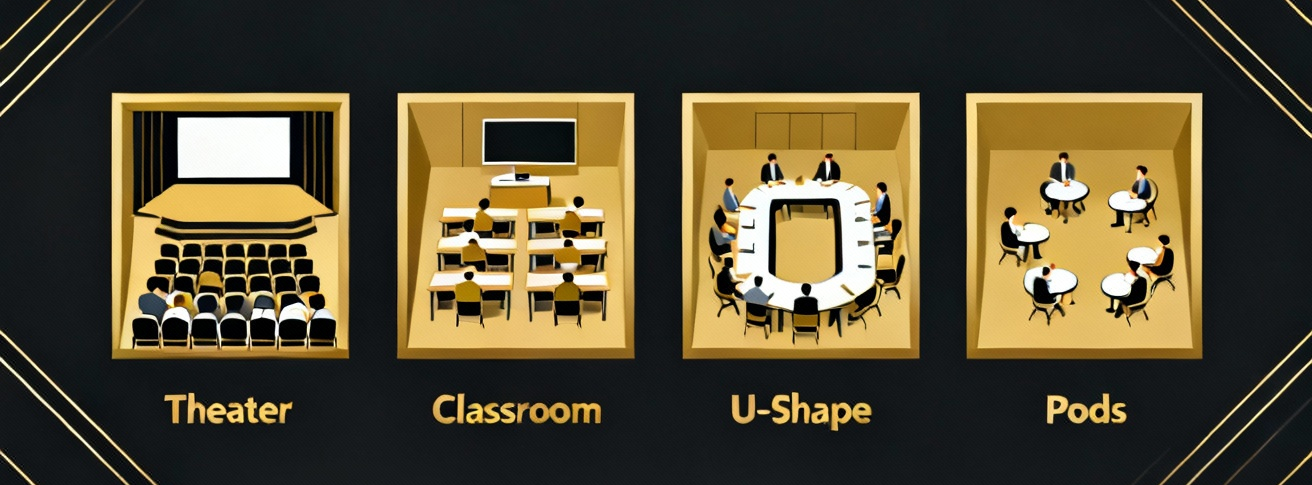
Understand different room layouts
The same room can feel very different depending on the setup.
- Theater style: just chairs, no tables. Best for lectures and presentations. Highest capacity.
- Classroom style: rows of tables and chairs facing the front. Great for trainings with laptops or note-taking.
- U-shape or hollow square: perfect for discussion, board meetings, and collaborative sessions.
- Pods or rounds: tables of 4–8 people. Great for workshops and group work.
Ask your venue for capacity charts for each layout. “Fits 60 people” might mean 60 in theater style but only 36 in classroom.
Consider more than the numbers
Capacity charts are a starting point, not the whole story. Two rooms that both “fit 40 people” can feel totally different.
Things that affect how the room feels:
- Ceiling height. Higher ceilings feel more spacious and less stuffy.
- Columns or obstructions. Anything that blocks sightlines to the screen or speaker reduces effective capacity.
- Natural light. Windows can make a smaller room feel more open.
- Where the door is. You don’t want people squeezed in front of the only exit.
When you tour, stand in the back of the room and imagine it full. Could you comfortably see the presenter and screen? Would you be happy sitting there for a couple of hours?
When in doubt, go slightly smaller — or ask for two rooms
For interactive meetings, a room that’s a little on the cozy side is often better than one that feels empty. People are more likely to ask questions, discuss, and stay engaged.
For larger events, consider booking two rooms:
- A main room for plenary sessions
- A smaller breakout room for small group work or private calls
This gives you flexibility without forcing everyone into a space that doesn’t fit the agenda.
Questions to ask your venue
- What’s the capacity of this room in theater / classroom / U-shape / pods?
- Do you have photos of those setups?
- What’s the largest group you’ve comfortably hosted in here?
- Are there other rooms we could add for breakout or overflow?
- If our headcount grows, what’s our upgrade option?
A good conference center won’t just rent you a room — they’ll help you choose the right one.